
Interview with Sébastien Rohmer

Can you tell us a bit about yourself
(education, career path, date you took over the farm, etc.)?
I studied at the agricultural college in Obernai, where I took a baccalaureate in Agronomy and Environmental Sciences and Technologies, followed by an advanced technician's certificate in Agricultural Business Analysis, Management and Strategy. Finally, I completed my studies with a degree in Marketing and Management in Strasbourg.
I worked outside the farm for ten years, the majority of the time as a prevention advisor at the CAAA (Caisse Assurance Accident Agricole – Agricultural accident insurance fund).
I was faced with two options: either to stop milk production on the farm and continue as an employee at the CAAA, or to take over the farm with the animals. I gravitated towards the second option, taking over the family farm on 1 January 2020.
Taking over the farm was a personal challenge for me, a choice I don't regret, because I love working on the farm.

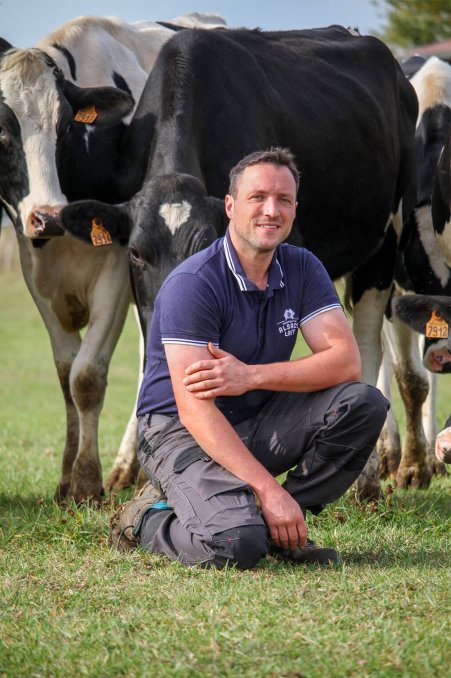
Tell us about your farm.
We currently have around 60 Prim'Holstein cows, on an area of almost 100 ha.
I'm the manager, with my mother Angèle working part-time and an apprentice. My father Francis, now retired, also regularly helps us.
We use a robot milking system for our cows.
We also sell vegetables, rapeseed oil and milk, etc. directly from the farm.
What made you want to follow in your family's footsteps?
When I was 18, wanting to take over the farm was already in my mind. It was important for me to ensure the continuity of the family farm, while trying to develop the system by making improvements.
What do you think are the advantages of being in a cooperative?
The main advantage is the proximity of governance, as the directors are also farmers. My father was a member of the Alsace Lait Board of Directors for a long time.
We are shareholders in the Cooperative and can benefit from the redistribution of part of the profits.
The milk collected from your farm is labelled 'PASTURE-RAISED MILK'. What are the steps involved in obtaining this label? What are the advantages of pasture-raised milk?
We contacted the dairy to find out about the process in 2019; Alsace Lait was looking for new producers to develop the process.
We then planted an additional four hectares of grass in order to comply with the specification of ten milk cows per hectare.
My idea was to produce organic milk, but the farm doesn't allow for that in terms of surface area. I found myself producing pasture-raised milk because of animal welfare. I attach as much importance to cows as I do to people.
Since I've been producing pasture-raised milk, I've noticed that the animals are healthier, particularly their hooves. I also notice that their behaviour is better.
Next step: I'd like to plant some trees to give my cows some shade.
What projects have you been working on since setting up?
My first investment in milk production was a milking robot. At first, I was worried that it would dehumanise the human-animal relationship, but the opposite has happened. The cows no longer see me as a hindrance; before, we had to push them to be milked, but now they're free to go and be milked whenever they like. Nowadays, I regularly walk among my herd and they don't back away any more; the relationship is calmer.
I've also made some alterations to the barn: improved comfort, mattresses, fans, brushes, calving stalls... with the aim of improving the well-being of my cows.
As far as the rest of the farm is concerned, I have converted 15 ha to organic farming, for cereals and oilseeds with a view to producing oil.
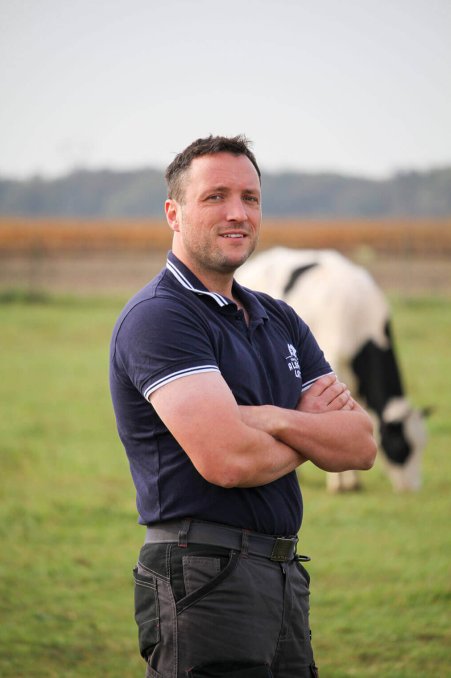
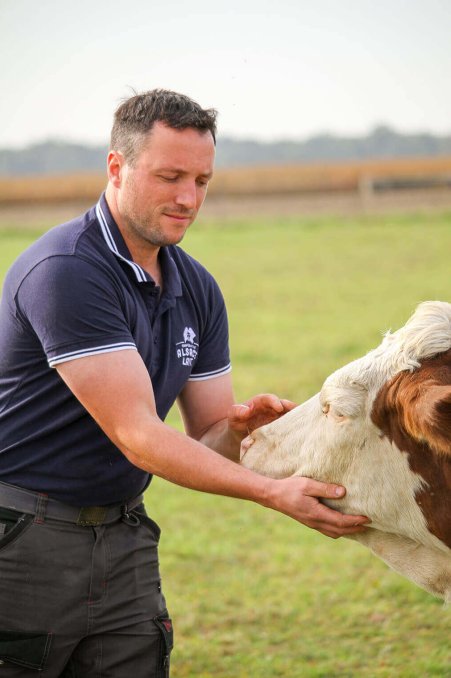
What are the advantages of your job?
Being a farmer means you do a wide range of jobs; you're a Jack-of-all-trades: veterinary assistant, accountant, mechanic, livestock farmer, cereal farmer... no two days are the same!
What drives me is developing my farm, improving the system.
Do you have any advice for young people wanting to enter the profession?
I'd advise them to get some experience outside farming: it opens up their minds.
I also think it's important to have some basic financial training, such as an advanced technician's certificate in Agricultural Business Analysis, Management and Strategy: it's essential if the business is to be sustainable in the long term.
Would you like to pass on your way of working to the general public?
I'm already doing that. Every month, students from the Obernai apprentice training centre come to my farm and I show them how I work.
We also invite children to visit twice a year. We were also able to play host in the Eurometropolis bicycle tour of farms.
We're a farm in a town, so walkers stop by and want to talk to us. We explain what we do and how, so that people understand how a farm works.
We have a small shop where we sell products directly, so are happy to welcome consumers.
Finally, do you prefer plain bibeleskaes or with a layer of fruit?
With a layer of fruit, of course!
What can we hope for you for the future?
Greater understanding from the general public about the work we do. This lack of understanding can sometimes lead to damage on our farms.
We would also like to see a stable, profitable price, as we have today, to enable us to make a decent living from our work.