
A modern dairy farm

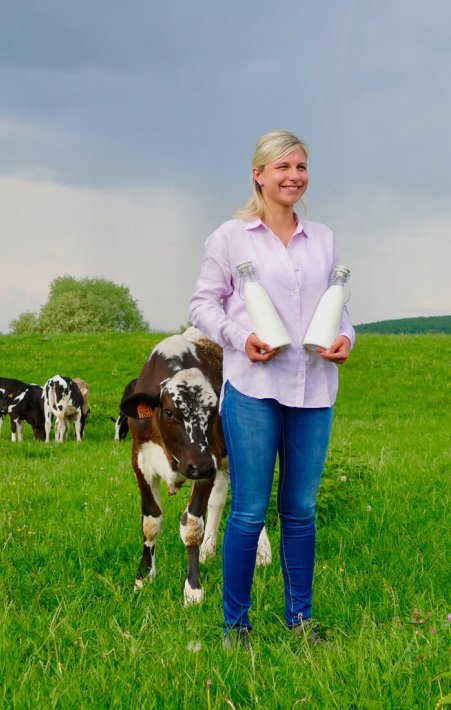
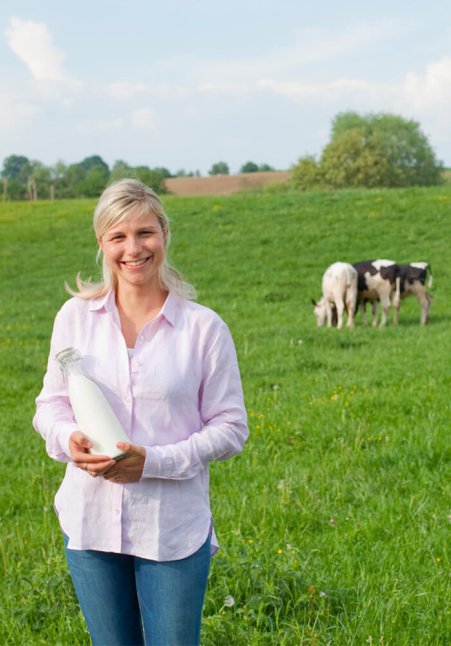
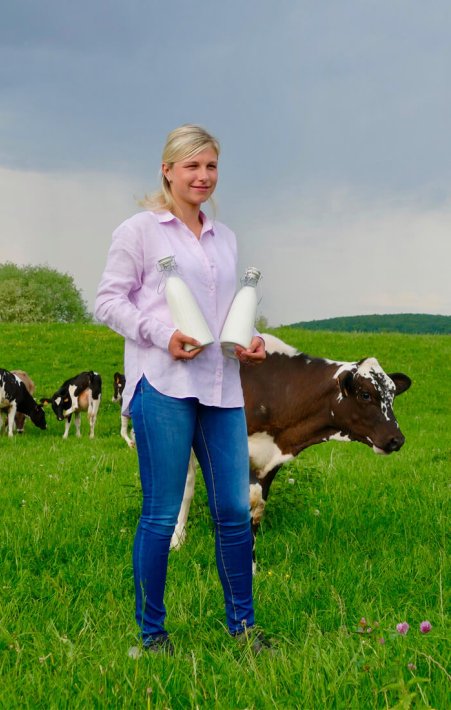
Some of our producers have chosen to modernise their dairy farms. We went to meet them and they told us their story. Meet Manuela, a bold woman who has gambled on new technologies...
Can you tell us a bit about yourself?
Hello, my name is Manuela Leonhart and I recently took over the family farm.
I wasn't destined to work on a farm... In fact, my career is a bit unusual. After leaving school with a science baccalaureate, I went on to study for an advanced technician's certificate as an executive assistant. But I felt out of place, so I changed direction.
In 2014, I took the BPREA, a professional certificate in agricultural management specialising in animal production. This is a one-year course for adults, equivalent to a vocational baccalaureate. As a result of this certificate, I have acquired skills that have enabled me to become a farm manager.

What made you want to follow in your family's footsteps?
I've always loved animals; I've always been surrounded by dogs, cats, horses, etc.
Being a dairy farmer was an obvious choice for me, but only when I realised that I wasn't going to be doing it on my own. And yes, my brother is also part of the adventure. It's a lot easier with two people, especially if you're a woman.
Despite all the changes, this job is still very physical. I'm glad I can have some help.
Have you been a dairy farmer for long?
As I was saying, I work on the family farm. Our company has been family-run for several generations. We are established as a GAEC (collective farming group).
I joined my younger brother and father on the farm in 2016. My brother is 22 years old and he followed a normal agricultural career path. My father is 52 and works on the farm with us.
The farm started in my grandfather's time. He always says "I started with one cow and one hectare" and as time went by, we expanded. Today, we have 180 hectares with fields of maize, wheat, barley, alfalfa and temporary grassland.
How many cows do you have on the farm?
We currently have 260 animals on our farm, including 120 dairy cows and 2 milking robots. It is important to stress that we have modernised our farm as much as possible.
The building we are in at the moment is very new. We set up in here in May 2017. We designed it to optimise animal welfare and make the work less arduous.
What are the advantages of your job?
What I like about this job is the versatility. We all know how to do lots of things.
It's a technical and very manual job. Personally, I don't do any clearing out, but I do the accounts,am responsible for the computer and the milking robots, and I do all the production monitoring.
So, in the end, being a dairy farmer means being as close as possible to the animals, but also being an accountant, technician, vet and many other jobs at the same time.
Then, I like the fact that we are our own bosses. There's no one to tell us what we have to do, when and how. We can organise our time as we wish.
And finally, I'm proud to say that we are continuing to work on the family farm. Our parents, my two brothers and I are proud to keep alive what my grandfather created and we hope that it will live on.
You have a very modern operation; what does this technology bring you today?
I think you have to keep up to date and move with the times. Now in our twenties, we want to break the image of the peasant woman in boots. We like to be organised so that things are calmer at weekends and we can take a bit of a breather.
You know, a farmer's job is a difficult one... It's a labour of love, 365 days a year. Installing a milking robot means we can enjoy life, and it provides relief to our cattle which can go and be milked as they please (within reason... we control it, of course).
We often work a bit more on Saturdays so that we only have the minimum to do on Sundays. This means looking at cows that are late or have gone over their milking times. We also take care of regrowing the fodder and managing maintenance.
Thanks to technology, if we organise ourselves well, everything is sorted out in an hour and we can enjoy our Sundays with the family. Before, fixed milking times were very restrictive.
So, with the milking robot, can the cows come and be milked whenever they want?
Yes, exactly, they can come and be milked 24/7. When they arrive beside the robot, the machine automatically recognises them from their collar.
The robot is smart in a way. It can refuse a cow that has come too many times, to avoid damaging her udders, for example. Everything is recorded electronically. If a cow exceeds her number of litres of milk, the machine will also refuse her.
Why can't they be milked ten times a day?
Above all, it's to maintain and guarantee a healthy udder. The teat has to close up from time to time, otherwise bacteria can enter and infect the milk or make them ill.
In general, they are milked four times a day. But some, those that produce a lot of milk, can go between four and five times a day. Every cow has to be milked at least twice a day.
How did the cows realise that they had to go and be milked on their own?
When we first installed the robots, we worked weeks of 3×8 shifts , i.e. we milked three times a day with daytime and night-time milking. My parents did the daytime milking and my brother and I did the night-time milking.
There were three groups every eight hours and we went to fetch them one by one. When one group was finished, it was the turn of the next group and so on. So, we worked like that for seven days and after a week, we let them go. By then, they'd already understood, because after being milked three times a day, they'd got used to it.
We followed the manufacturer's protocol. We are well supported. They like the machine because it relieves them when they have too much milk. And there are even minor skirmishes between them. Those desperate to be milked and the most dominant will head-butt the others, pushing those in front to pass in front of them. It's just nature at the end of the day! But in the end, it's worked out well for everyone.
Do you have any advice for young people wanting to enter the profession?
Start up or take over a farm?
If they want to go it alone, I say good luck to them. For me, it's important to have an example, a role model. My parents guide us as we learn. They have hindsight and experience. That's a real asset.
If they start out on their own, they'll also have to get used to the demanding work schedule, not to mention the financial aspect which seems impossible to manage on your own...
I think the only young people to succeed are those who want to set up on existing farms, because creating one is really very complicated.
In any case, you have to have the right temperament and a passion for it, because if you're just doing it for the money, it might not be the right field, ha ha ha...!
One last piece of advice! I think you have to be well-organised to have a certain quality of life. Thanks to our investment in the robots, we've got more free time again and that's great.
What do you think are the advantages of being in a cooperative?
I know that there's a production committee, and some of my friends are members, so if we want to pass any messages on, we can do it through them.
It's a real advantage being with Alsace Lait, because there aren't a lot of us and they really listen to us.
Would you like to pass on your way of working to the general public?
My brother and I are members of the Young Farmers' Association. So, every year, we organise open days. We also open our doors to the general public to show them how we work and how the animals are doing. I think there's still a real lack of communication between animal welfare and our new working methods.
Finally, as a producer, do you prefer skimmed or whole milk?
As producers, we obviously prefer whole milk!
What can we hope for you for the future?
We're hoping for better times and want consumers to try and understand us. We try to do the best we can for ourselves and for our animals...
Thank you!